
ZED ZONE Base Building: Voxel Guide
ZED ZONE base building in 1.0: voxel blocks, the indoor rule, the station order, power, storage, and a base layout that survives the first horde.
The 1.0 build replaced the old prefab base system with voxel construction. You can place floors, walls, roofs, and stairs block by block, stack a second floor, and put furniture on it. That freedom is great, and it is also how new players build a beautiful house with no door and freeze to death inside.
This guide covers the shell, the station order, the indoor rule, and a layout that is cheap to build and easy to defend. It assumes you have a workbench and a few hundred wood and stone.
Official source: ZED ZONE on Steam ↗
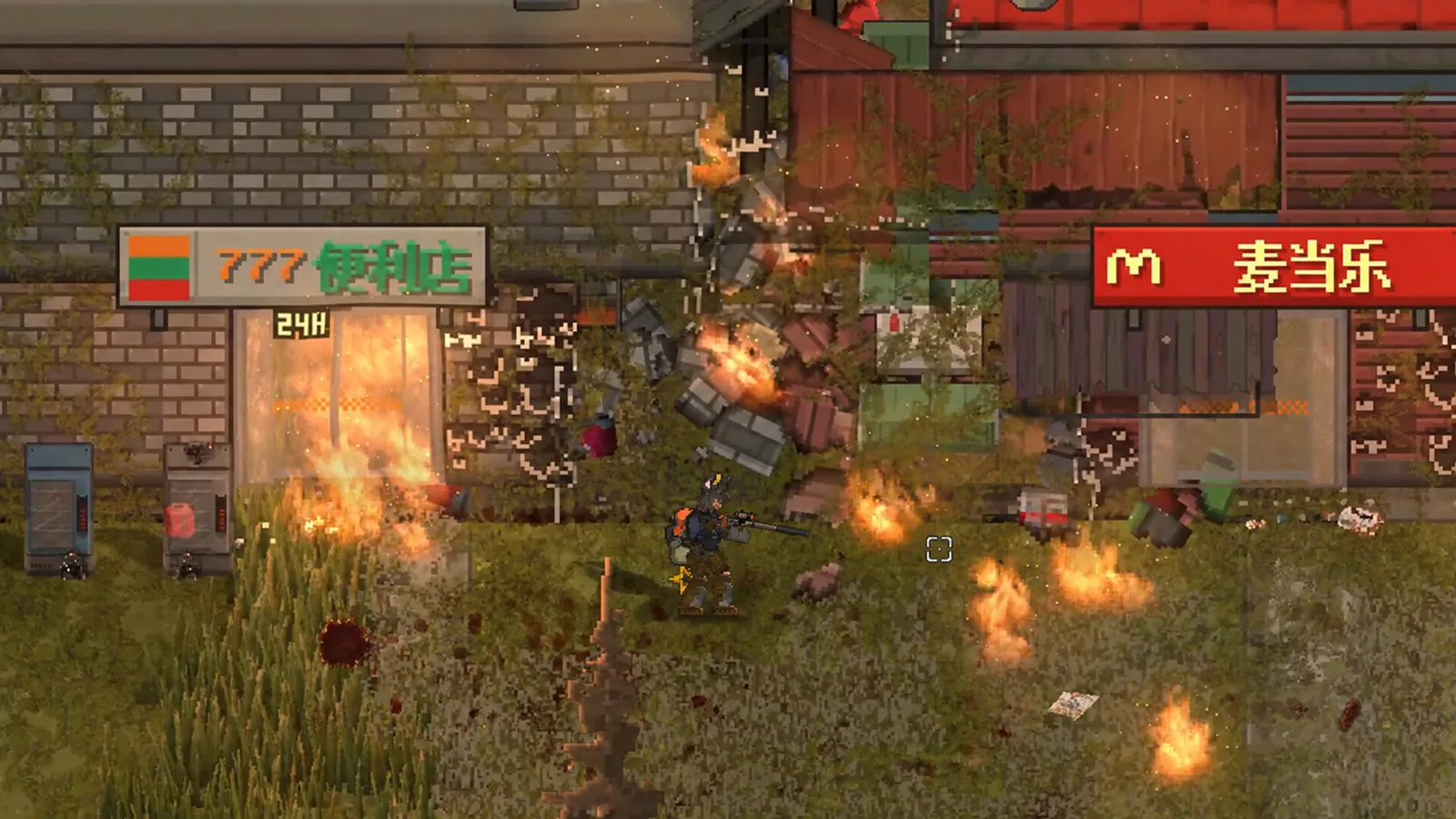
A small sealed core with a door, bed, and bench is safer than a half-finished palace. Expand only after the walls, roof, and door are all in place.
Pick the right location
A base has four requirements: water, wood, a road, and a defensible approach.
- Water — a rain barrel or a well nearby. You can build a well later; the first week needs a source.
- Wood — a forest edge is better than a town centre. Wood is the cheapest wall material.
- Road — a vehicle needs a clear path. A base in the woods looks safe until you cannot drive to it.
- Approach — one narrow side is easier to defend than four open sides.
Avoid military checkpoints, hospitals, and dense town centres for the first base. They have good loot and too many spawns. A farmhouse outside town, a warehouse on a road, or a fenced yard is a better first site.
The voxel shell
The 1.0 building system uses five material blocks: wood, stone, metal, glass, and hay. Each has a different durability and cost. Wood is cheap and fast; stone is the mid-game standard; metal is for doors and critical walls; glass is for light; hay is for insulation and decoration.
A minimal shell:
- Floor — a 5×5 or 6×6 platform. Flat ground is easier; a slope needs foundation blocks.
- Walls — four sides, two blocks high. Leave a door frame on the safe side.
- Roof — cover the whole interior. A roof is not decoration; it is part of the indoor rule.
- Door — a real door, not a gap. Close it when you sleep.
- Stairs — if you build a second floor, place stairs inside the shell.
The 1.0.5 patch added green, yellow, and red placement outlines. Green is valid, yellow is a warning, red is blocked. If the outline is red, the block will not place; do not force it.
Ctrl plus the mouse wheel locks the build layer, which is how you place a wall on the second floor without accidentally building on the ground. The how-to-play guide→ lists the default build keys.
The indoor rule
A room counts as indoors when it has four walls, a roof, and a closed door. Indoors, you are not rained on, and stations that dislike weather work normally. This is a 1.0.5 change and it matters for cooking, sleeping, and long crafting sessions.
The rule is literal. Three walls and a roof is not indoors. Four walls and no roof is not indoors. A closed door is part of the check; an open doorway breaks it. If your character is still getting wet inside, walk around the room and look for a missing wall block or an open door.
Station order
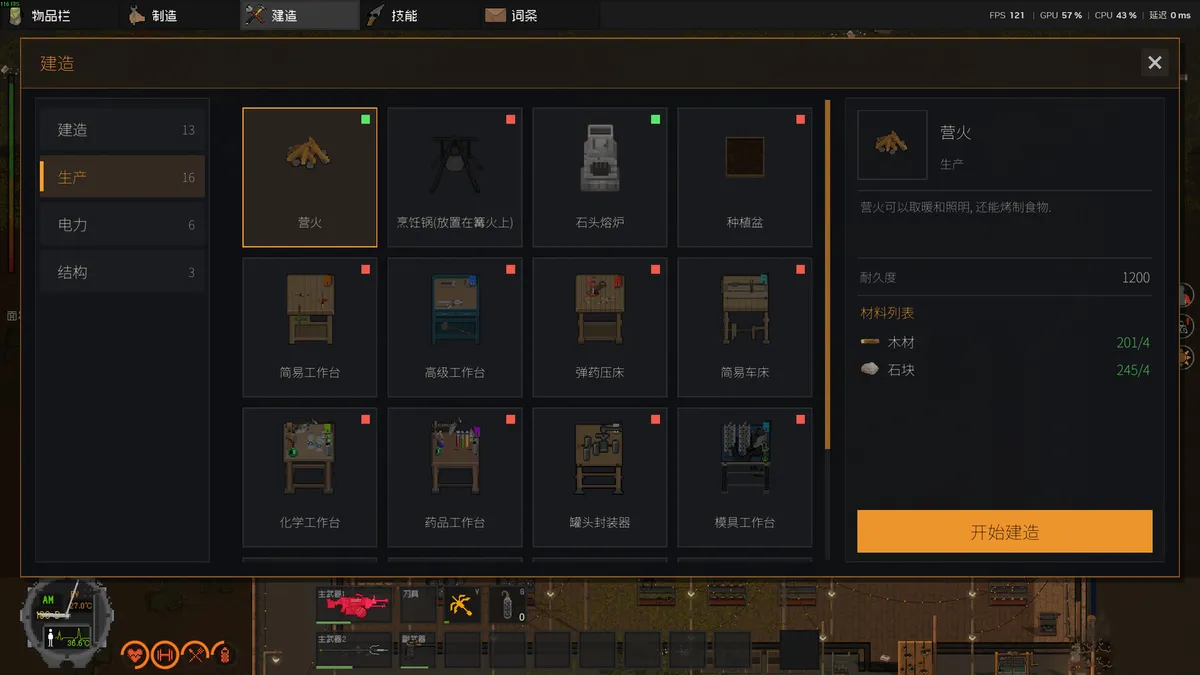
Build stations in this order. Each one unlocks the next tier of recipes.
| Order | Station | Why |
|---|---|---|
| 1 | Campfire | Light, warmth, cooking, water boiling |
| 2 | Cooking hob | Clean water, meals, better food |
| 3 | Stone furnace | Smelting, metal parts, glass |
| 4 | Simple workbench | Basic crafting and repair |
| 5 | Planting pot | Food independence |
| 6 | Advanced workbench | Better gear and stations |
| 7 | Ammo press | Reloading and ammo supply |
| 8 | Simple lathe | Precision parts |
| 9 | Chemical bench | Explosives, fuel, advanced materials |
| 10 | Pharmaceutical bench | Medicine and potions |
| 11 | Canning machine | Long-life food |
| 12 | Mold workbench | Specialised parts |
Do not build all twelve on day one. The first five solve survival; the rest are mid-game. A campfire plus a cooking hob plus a workbench is a functioning base.
The crafting guide→ covers the recipes and the material chain.
Power
The 1.0 build has more than ten powered facilities, including lights, a fridge, an electric fence, and battery storage. Power comes from generators and, later, solar and other sources.
A simple power setup:
- Generator — place it outdoors or in a ventilated room. It needs fuel.
- Battery module — stores power for the night.
- Lights — one per room; do not light the outside of your base like a stadium.
- Fridge — keeps food fresh; a luxury, not a first-week need.
- Electric fence — a defensive ring, not a replacement for walls.
The electric fence needs a Stirling Generator and a power connection. The Tesla turret needs a High-Power Battery Module. Plan the power layout before you build the walls; retrofitting cables through a finished base is annoying.
Storage and layout
A practical 6×6 base:
- Entry room — door, a chest for dirty loot, a light.
- Workshop — workbench, lathe, ammo press, repair kits.
- Kitchen — fire, cooking hob, water barrel, fridge if you have power.
- Bedroom — bed, a second exit, a window.
- Roof — water collector, planting pots, a clear line of sight.
Keep the workshop away from the bedroom. Noise from crafting can pull infected, and you want a wall between them and your respawn point. Put the bed near a window or a second door so you are not trapped.
Defense is part of the build
A wall without a plan is a delay, not a defense. The first layer is a fence or a spike line; the second is a wall; the third is a fallback room with a door you can close.
Spike traps, landmines, and turrets are covered in the base defense guide→. For the first week, a wooden spike line on the approach and a door you actually close are enough.
Common building mistakes
- No roof. The indoor rule fails, rain gets in, and the base is cold.
- One door, no second exit. A Breaker in the doorway traps you.
- Building in a POI. You cannot defend a military checkpoint with wood.
- Too many windows. Glass is not armour.
- No light inside. You cannot fight what you cannot see.
- Forgetting the power plan. Cables and generators need space.
Co-op building
The host's base is the only one that persists. Guests can place blocks and stations, but the changes live in the host's save. Agree on a layout before you build; a guest who adds a wall across the workshop is a problem.
Use shared chests for materials and personal chests for gear. The host should keep the repair kits and the fuel in a locked room or a chest the group agrees not to empty.
FAQ
Do I need a roof?
Yes. Four walls plus a roof plus a closed door is the indoor rule; without a roof you are outdoors.
What is the best base material?
Stone for walls, wood for the first shell, metal for doors and critical blocks. Glass is for light, not defense.
Can I build more than one floor?
Yes. Voxel building supports multiple floors, and furniture can be placed upstairs.
Does the base save in co-op?
The host's save contains the base. Guests keep their characters, not the base.
Sources
- ZED ZONE store page ↗ — voxel building, power, stations.
- ZED ZONE news hub ↗ — 1.0.5 indoor detection and build outlines.
- ZED ZONE Community guides ↗ — station lists.
- ZED ZONE on SteamDB ↗ — build history.
More ZED ZONE Guides
ZED ZONE console commands for 1.0: how to open the console, the four working command types, and a verified item and infected ID table.
ZED ZONE crafting in 1.0: the eight workbenches, the material chain, ammo press recipes, repair kits, and the order to unlock each station.
A ZED ZONE enemies guide: every infected type, the mechs and war machines, the Giant Mutant Lizard, and the tactics that actually work against each.
ZED ZONE Far Island guide: how to repair the boat, the ten new areas, the railway power loop, and a route that reaches Area 61 without wasting trips.
ZED ZONE farming in 1.0: planting pots, twelve crops, watering and fertilizer, mushroom caves, and the recipes that make a farm worth the space.
ZED ZONE food and cooking: clean water, the campfire and hob, meal buffs, preservation, food poisoning, and the best meals before a boss.
A practical ZED ZONE 1.0 guide: what changed, which route to take first, and the systems that decide whether your run survives week one.
How to play ZED ZONE in 1.0: the full keyboard map, mode selection, save rules, and the first-hour route that gets a new survivor to a stable base.